

- What chronic medication benefits are and how they differ from your medical savings account.
- Why chronic cover is not automatic, even for PMB conditions.
- How unregistered chronic medication is often paid from savings
- The financial impact of repeat scripts over a year.
- The conditions most commonly overlooked when it comes to registration.
- What the registration process changes in practical terms.
- When to ask MedXpert to review your benefits and explain what applies to your option.
The hidden cost of not registering for chronic benefits
Note: The benefits mentioned below may vary depending on your specific plan. For accurate, personalised information, please contact MedXpert. We can help you compare plans and register for available programmes.
Mental health has become a vital part of overall well-being and, increasingly, a key feature of South African medical scheme offerings. With more schemes incorporating structured mental wellness support into their benefit designs, it’s never been more important to understand what your plan includes.
Medical aids now offer a variety of mental health benefits: structured programmes, virtual counselling, medication support, and app-based coaching. But not all benefits are created equal and what you have access to depends heavily on your specific scheme and option.
The need for mental health care in South Africa keeps growing. According to the South African Depression and Anxiety Group (SADAG), 1 in 3 South Africans will experience a mental health condition during their lifetime. Access to treatment remains limited. WHO reports South Africa has 1.52 psychiatrists per 100,000 people. That figure shows the gap between demand and available care. Medical schemes have started responding. The Council for Medical Schemes (CMS) Annual Report shows more schemes adding structured mental health benefits each year.
Knowing what your plan covers places you in a stronger position. You may already be paying for support you haven’t accessed yet.
What does mental health care cost out of pocket?
Even with solid medical scheme cover, mental health care can carry unexpected out-of-pocket costs. Most out-of-hospital mental health benefits come with an annual Rand limit, and once that runs out, you’ll pay in full for any further sessions (or medication) until your plan resets with the new benefit year.
A standard psychologist session is typically billed at between R1,200 and R1,800, but your scheme may only reimburse at a lower scheme rate, leaving you to cover the gap. Keep in mind that if you are admitted to a private mental health facility that is not a Designated Service Provider (DSP) or falls outside your scheme’s network, a co-payment of 20% to 30% on the full admission cost can apply. For non-PMB mental health admissions, some gap cover products may help offset shortfalls, though this depends on your specific policy.
Speak to a MedXpert advisor to understand where your exposure lies and whether your current cover is sufficient.

Why mental health benefits should be on your radar
- Therapy costs money. Regular sessions place pressure on household budgets.
- Stress and anxiety continue rising. Work, finances, parenting, caregiving, and daily pressure affect people across all income levels.
- Support is now built into some plans: Medical schemes are beginning to respond with real, structured benefits, but they differ significantly by provider.
What are Prescribed Minimum Benefits for mental health?
Prescribed Minimum Benefits (PMBs) are a legal protection built into every registered medical scheme in South Africa. They define a set of conditions that your scheme must cover, regardless of your plan level.
For mental health, PMBs work through two frameworks: Diagnosis Treatment Pairs (DTPs) and the Chronic Disease List (CDL).
A DTP is a specific combination of a diagnosed condition and the treatment your scheme is required to provide for it. Each mental health condition listed under PMBs has its own DTP, which sets out what care must be covered and at what level.
The CDL is a separate list of chronic conditions that your scheme must cover on an ongoing basis. For mental health, this includes conditions like schizophrenia and bipolar mood disorder, where long-term medication and management form part of the required cover.
The mental health conditions covered under PMB DTPs and the CDL include schizophrenia, bipolar mood disorder, major depression, and substance use disorders, among others.
What this means in practice:
- For conditions listed in the DTPs, your scheme must cover hospitalisation and acute crisis treatment.
- For conditions on the CDL, your scheme must cover the ongoing management of that condition, including chronic medication.
- PMB cover applies at cost, meaning your scheme cannot refuse it based on your plan level.
- Out-of-hospital care is a different story. Day-to-day therapy and ongoing support are not standardised under PMBs. What you actually receive depends on your specific scheme and benefit option.
Think of PMBs, DTPs, and the CDL together as your safety net for the most serious mental health conditions. They set the floor. For everything beyond that floor, your benefit option is what determines your cover.
Snapshot of mental health benefits offered
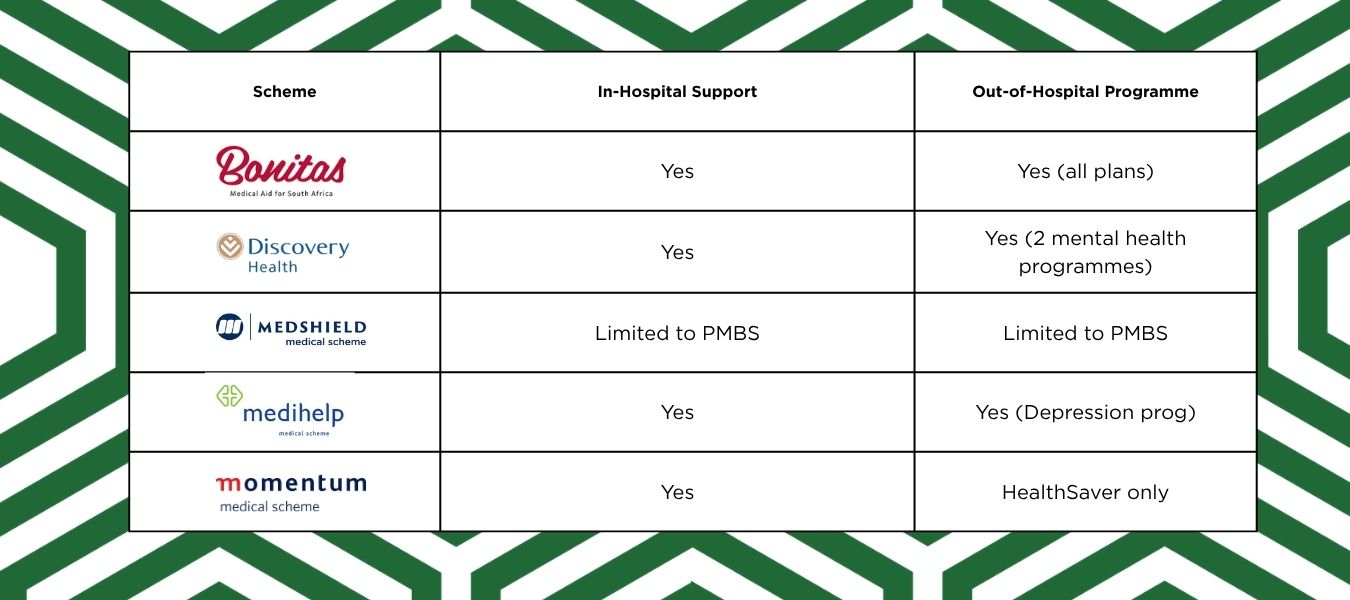
Here’s a quick summary before we unpack the detail:
- Bonitas: Counsellors, app support, chronic medication benefits, and a dedicated Mental Health Programme.
- Discovery: Structured managed care programmes, including a 6-month care programme, digital CBT tools, virtual consults, and rewards through Vitality.
- Medshield: Strong in-hospital and out-of-hospital cover.
- Momentum: In-hospital care only (unless self-funded), plus access to the Wysa app through Multiply. Strong in-hospital and out-of-hospital cover.
- Medihelp: Depression programme, out-of-hospital psychologist visits.
- Momentum: In-hospital care only (unless self-funded), plus access to the Wysa app through Multiply.
Mental health support by scheme
Bonitas
Mental health programme
Bonitas offers a dedicated programme for members with depression, anxiety, PTSD, and alcohol abuse. Bonitas offers structured mental health support across all plans, including medication and consultation limits, with easy app access. Once registered, you’ll be paired with a dedicated counsellor who collaborates with your doctor and provides long-term support.
- Chronic medication for depression covered up to R165 per month (subject to DSP use and Chronic Programme registration).
- Educational content provided to help you manage your condition.
- Available across all plan types, including BonCap.
These programmes are designed to manage long-term conditions effectively within scheme protocols and many schemes offer more than just chronic management programmes.
Digital support
Bonitas members have access to the October Health app (formerly Panda), a mental health platform offering anonymous audio-only sessions with peer supporters and mental health professionals. Members can also seek general guidance from an AI assistant named Dr B, available on the Bonitas website.
Hospitalisation benefits
Mental health consultations are covered both in and out of hospital:
- Primary: Up to R9,780 per family per year.

Discovery Health
Mental health care programmes Discovery offers two structured programmes. It has a specific Mental Health Care Programme, including but not limited to depression, and it has a 6-month Depression Risk Management Programme.
Here are the differences between the 2 programmes:
Depression Risk Management Programme:
- Access to face-to-face counselling.
- Includes GPs, psychiatrists, psychologists within the network.
- Available to members upon diagnosis and registration.
Mental Health Care Programme:
- Virtual / face-to-face psychotherapy counselling (individual or in groups).
- Includes GPs, and psychologists.
- Antidepressant medication funding.
- Members with depression can also access a relapse prevention programme.
Digital tools
Digital tools Members can access:
- Mental well-being assessments. Virtual consultations.
- Guided digital iCBT (Internet based Cognitive Behavioural Therapy) modules.
Vitality rewards
Vitality members earn points for completing mental health assessments and wellness activities, helping you stay consistent with your care.
Medshield
Taking care of your mental health is just as important as your physical wellbeing, and Medshield’s medical plans reflect this commitment. Here’s a clear breakdown of what you can expect when it comes to mental health cover:
- Hospitalisation for Mental Health: All Medshield plans cover mental health hospitalisation under the Prescribed Minimum Benefit (PMB) at the required level of care. This means essential mental health treatments in hospital are protected.
- Non-Network Hospital Admissions: If you are admitted to a mental health facility outside Medshield’s network, you may be subject to a 30% upfront co-payment, depending on plan type. This is important to keep in mind when choosing your treatment provider.
- Out-of-Hospital Mental Health Care: Consultations with psychiatrists, psychologists, and other mental health professionals outside of hospital are typically paid from your day-to-day or savings benefits, but this depends on the specific plan you’re on.
When it comes to limits on mental health benefits, Medshield offers different levels based on your plan tier:
- PremiumPlus (Top-tier): R100,000 per annum
- MediPlus (Middle tier): R40,300 per annum
- MediCurve (Entry-level): Coverage is subject to PMB regulations
Medihelp
Medihelp’s Depression Management Programme offers essential support with day-to-day treatment, like monthly medication and mental health consultations, Further benefits are also offered, such as in-hospital care and guidance through a wellness app. This comprehensive approach makes managing depression more accessible and supportive.
Depression management programme
Includes:
- Monthly medication allowance.
- Annual limit for out-of-hospital mental health consults.
Example:
On MedVital:
- Hospitalisation and psychiatric services: R25,000 per beneficiary per year to a maximum of R38,200 per family per year.
- Out-of-hospital treatment: R3,150/year (with registration).
- Medicine: R100 per beneficiary per month, subject to the in-hospital limit provided above.

Momentum
Momentum’s cover is heavily weighted toward in-hospital care, unless you’ve opted into the HealthSaver offering. The Wysa app is a helpful digital tool but isn’t integrated into rewards.
In-hospital support
Mental health care is covered only during hospital admission, subject to authorisation.
Out-of-hospital support Generally not included unless members use their HealthSaver account, a voluntary self-funding option.
Digital coaching
Multiply members (any level) can access Wysa, a 24/7 AI-powered app that supports anxiety, sleep issues, and depression.

Is your mental health cover working for you?
Use this quick checklist to see whether you’re making the most of your mental health benefits:
- Do you know if your scheme has a registered mental health programme?
- Are you using your scheme’s digital mental health app?
- Have you checked whether your psychiatrist or psychologist is a Designated Service Provider (DSP)?
- Do you know your annual rand limit for out-of-hospital mental health consults?
- Are you registered for chronic medication benefits if you’re on antidepressants or mood stabilisers?
- If you answered “no” or “not sure” to any of the above, we can help.
What about wellness and rewards?
Rewards platforms are making it easier to stay mentally well by turning self-care into everyday habits. Medical schemes are now integrating mental health into their incentive structures:
- Vitality (Discovery): Earn points by completing assessments and engaging with mental wellbeing content.
- Multiply (Momentum): Access Wysa on all levels. Though it doesn’t affect HealthReturns, it’s a valuable tool.
Your next step
It’s clear that mental health benefits differ vastly depending on the scheme and plan level. Whether you’re comparing options or trying to understand your current cover, having the right information can help you access the care you need.
Not sure what mental health benefits you currently have or if you’re missing out on something better?
Complete this quick MedXpert form and one of our experts will contact you directly to walk you through your mental health benefit options, programme eligibility, and how to register. This allows us to track your request and give you personalised advice based on your current scheme and plan.
Take the first step toward better mental well-being today, with the support you’re already paying for.
Frequently asked questions
Is seeing a psychologist covered differently from seeing a psychiatrist?
If you are being treated for PMBs, then no. They come from the same benefit under your PMB: You will get 30-days in-hospital or 15 consultations for either a psychologist or a psychiatrist. If you are seeking treatment out-of-hospital, then yes, cover for a psychologist does differ from that of a psychiatrist. It’s important to look at how your specific scheme treats out-of-hospital mental health cover so that you know if your scheme would prefer for you to seek treatment at a psychiatrist or a psychologist.
What’s the difference between a savings benefit and a risk benefit for mental health?
Medical savings in your medical aid is a predetermined allocated rand amount that gets taken from your monthly premium according to a specific percentage (up to 25%). Once depleted, you pay for benefits that would typically be paid for from savings from your own pocket. A risk benefit comes from pooled scheme funding and doesn’t run out in the same way. Most psychiatry consultations fall under risk-benefit analysis.
Can I use my medical scheme to cover mental health treatment for my child?
Yes. Registered dependants share your plan’s mental health benefits. Contact MedXpert to confirm how limits apply on your plan.
What happens if I’m admitted to a private mental health facility without prior authorisation?
Your claim may face reduction or rejection. Most schemes require authorisation before admission or within 48 hours after admission. During emergencies, the facility’s case manager will obtain authorisation on your behalf, but it can also be obtained by a family member (granted that that family member is on the same medical aid plan as you, or that they have consent to speak to the medical aid on your behalf).
Does my scheme cover online or virtual therapy sessions?
Many schemes do. Coverage terms differ between providers. Check if your specialist forms part of the approved network or speak to a MedXpert advisor for plan-specific guidance.